The problem with wind power is matching supply with demand. High winds at night can produce more power than needed while on cold, still days the turbines produce nothing at all. Storing electricity has always been difficult and most systems, like flywheels, capacitors or lead-acid batteries are either too expensive or too small. Pump storage is a large-capacity solution. It uses surplus power to pump water up to a reservoir. This water is released to turn hydro-electric turbines at times of high demand. Pump storage is expensive, and needs the right kind of geography with mountains and lakes.
Research in Australia (New Scientist 13th January 2007) has developed the flow battery. This uses electrolytes consisting of chemical solutions based on the element vanadium. The electrolytes are pumped into the flow cell where they are charged by the wind turbines and then pumped out to storage tanks. The size of the battery is therefore only limited by the size of the tanks. When the wind drops the electrolytes are pumped back into the flow cell where they release their electricity. Systems have already been successfully installed and improved the productivity of wind farms by buffering the differences between supply and demand. So far the flow battery is too large to fit in a vehicle, but research continues with alternative chemical compounds for the electrolyte.
At this stage the system is expensive and the future success of flow storage batteries must depend on the cost and availability of vanadium.
Tuesday, February 06, 2007


Monday, February 05, 2007
FAR Out
The Fourth Assessment Report (FAR) has just been released by the United Nations’ Intergovernmental Panel on Climate Change. (IPCC) No real surprises. We expected the news to be bad and the report says things are getting worse and urges governments again to take action to avoid total catastrophe.
How likely is it that governments will respond? The United States and Australia refused to sign up to the Kyoto Protocol on the reduction of greenhouse gases, and the process of designing a new protocol, to apply after 2012, is stalled. While Britain will reach its Kyoto target, this is mainly due to the closure of coal-fired power stations in the late 90s. Britain’s greenhouse gas emissions are once again rising. Britain is still building roads and expanding airports. Germany has just buckled under to the automotive lobby and relaxed emission standards for new cars. China, which as a developing country was not required to make emission reductions under Kyoto, continues to expand, to use increasing quantities of coal and to produce 15% of the world’s CO2 emissions.
Cutting emissions means cutting the use of fossil fuels or installing equipment to trap the CO2. In both cases this means extra costs: in both cases this will depress the economy. The US economy is already in bad shape so industrialists resist anything that might make it worse. Their tactic is to attack the science and suppress the evidence. The New Scientist (3rd February 2007) claims this is happening with the support of the US government, and that lobbyists who used to deny the danger of smoking are now attacking the climate scientists.
Not a reassuring prospect.
How likely is it that governments will respond? The United States and Australia refused to sign up to the Kyoto Protocol on the reduction of greenhouse gases, and the process of designing a new protocol, to apply after 2012, is stalled. While Britain will reach its Kyoto target, this is mainly due to the closure of coal-fired power stations in the late 90s. Britain’s greenhouse gas emissions are once again rising. Britain is still building roads and expanding airports. Germany has just buckled under to the automotive lobby and relaxed emission standards for new cars. China, which as a developing country was not required to make emission reductions under Kyoto, continues to expand, to use increasing quantities of coal and to produce 15% of the world’s CO2 emissions.
Cutting emissions means cutting the use of fossil fuels or installing equipment to trap the CO2. In both cases this means extra costs: in both cases this will depress the economy. The US economy is already in bad shape so industrialists resist anything that might make it worse. Their tactic is to attack the science and suppress the evidence. The New Scientist (3rd February 2007) claims this is happening with the support of the US government, and that lobbyists who used to deny the danger of smoking are now attacking the climate scientists.
Not a reassuring prospect.
Thursday, February 01, 2007
The Book
My book, "Will climate change your life? How to drive a 4x4 and still save the planet" will be published on 26th February.
Click here to find out more and to receive a free copy of my e-book "Europe's Energy Conundrum - the next 10 years."
Click here to find out more and to receive a free copy of my e-book "Europe's Energy Conundrum - the next 10 years."
Peak Oil - a Cuban case study
In January I spent two weeks in Cuba, and before I went I saw the video “The Power of Community – how Cuba survived Peak Oil” (www.communitysolution.org/cuba )
Cuba suffered an economic shock when the Soviet Union collapsed in 1990. For the previous 30 years it had been receiving substantial support, including technical assistance and cheap oil in exchange for sugar. All this stopped almost overnight. For the same 30 years the United States has operated a trade embargo and travel ban against Cuba, and this continues to the present day.
Cuba has some oil of its own, though not nearly enough for transport, electricity generation and – crucially – fertiliser and pesticide production. At the time of the Soviet collapse Cuba was using more fertiliser per acre than the US; agricultural production fell dramatically. Food rationing was introduced but the population began to suffer from malnutrition. The film shows how large state farms were broken up into individual co-operatives and how every spare piece of land in the cities was turned over to growing vegetables. With no fertiliser, agriculture had to be organic, and with no fuel for tractors, oxen and horses returned to the land. Farming became labour-intensive; more and more people became farmers.
In the early 90s power cuts were common - lasting up to 24 hours. If people could get to work (and transport was severely disrupted) they often had nothing to do because there was no power. It's only in the last few years that electricity cuts have largely disappeared. The solution has come in three ways. First, the ageing national grid has been superseded to a large extent by building a lot of neighbourhood generators to replace the few large power stations and the nuclear station that the soviets never finished. (Not CHP - in that climate you just don't need the heat!) Secondly the government has managed demand, and you don't see filament bulbs anywhere - they're all CFLs. There is also a programme to replace domestic appliances with more efficient ones. (But Cuba is a poor country, and the volume of domestic appliances must be small.) Thirdly, Fidel - or Raoul - is now big chums with Hugo Chavez in Venezuela which has lots of oil. (This is fortunate, as all generating plants, large and small, seem to be oil -fuelled.) Cuba has sent 20,000 doctors to Venezuela and receives oil in return. I've not been able to determine whether this is as much as Russia used to provide.
There is still a transport problem exacerbated both by oil shortages and by the lack of spare parts for vehicles. Mass transit is just that: people packed into goods lorries. Government vehicles of all kinds are expected to take hitch-hikers, and yellow-uniformed hitchhike co-ordinators are stationed at the side of the road to ensure that they do. Cuba was one of the first Latin-American countries to have railways. They are still there, but like the roads they are long overdue for repairs and maintenance.
So has Cuba successfully survived Peak Oil? The country certainly suffered an oil shock with far-reaching consequences, and while things are better than they were in the early 90s people say that things are still not what they were before the Soviet Union collapsed. The on-going US embargo has continued to make things difficult, though ironically Cuba still buys millions of dollars of food from the US, and Cuban expats in the States also send about $1billion back home each year. With only 11m people in 111,000 km2, [UK 60m – 242,000km2] the country has the potential to be self-sufficient in agriculture, but the command economy has been unable to achieve this. The 2006 Annual Economic Review notes that MPs at the Economic Committee complain of labour discipline problems which lead to low productivity, corruption and squandering.
Do we have a lesson for the rest of the world? The world will suffer similar problems from Peak Oil, but it is unlikely that they will arise quite as suddenly as they did in Cuba. The most important difference is that Cuba has replaced its Russian oil, at least to some extent, with Venezuelan oil. The world doesn't have such an option.
On a global scale, when the oil's gone, it's gone!
Cuba suffered an economic shock when the Soviet Union collapsed in 1990. For the previous 30 years it had been receiving substantial support, including technical assistance and cheap oil in exchange for sugar. All this stopped almost overnight. For the same 30 years the United States has operated a trade embargo and travel ban against Cuba, and this continues to the present day.
Cuba has some oil of its own, though not nearly enough for transport, electricity generation and – crucially – fertiliser and pesticide production. At the time of the Soviet collapse Cuba was using more fertiliser per acre than the US; agricultural production fell dramatically. Food rationing was introduced but the population began to suffer from malnutrition. The film shows how large state farms were broken up into individual co-operatives and how every spare piece of land in the cities was turned over to growing vegetables. With no fertiliser, agriculture had to be organic, and with no fuel for tractors, oxen and horses returned to the land. Farming became labour-intensive; more and more people became farmers.
In the early 90s power cuts were common - lasting up to 24 hours. If people could get to work (and transport was severely disrupted) they often had nothing to do because there was no power. It's only in the last few years that electricity cuts have largely disappeared. The solution has come in three ways. First, the ageing national grid has been superseded to a large extent by building a lot of neighbourhood generators to replace the few large power stations and the nuclear station that the soviets never finished. (Not CHP - in that climate you just don't need the heat!) Secondly the government has managed demand, and you don't see filament bulbs anywhere - they're all CFLs. There is also a programme to replace domestic appliances with more efficient ones. (But Cuba is a poor country, and the volume of domestic appliances must be small.) Thirdly, Fidel - or Raoul - is now big chums with Hugo Chavez in Venezuela which has lots of oil. (This is fortunate, as all generating plants, large and small, seem to be oil -fuelled.) Cuba has sent 20,000 doctors to Venezuela and receives oil in return. I've not been able to determine whether this is as much as Russia used to provide.
There is still a transport problem exacerbated both by oil shortages and by the lack of spare parts for vehicles. Mass transit is just that: people packed into goods lorries. Government vehicles of all kinds are expected to take hitch-hikers, and yellow-uniformed hitchhike co-ordinators are stationed at the side of the road to ensure that they do. Cuba was one of the first Latin-American countries to have railways. They are still there, but like the roads they are long overdue for repairs and maintenance.
So has Cuba successfully survived Peak Oil? The country certainly suffered an oil shock with far-reaching consequences, and while things are better than they were in the early 90s people say that things are still not what they were before the Soviet Union collapsed. The on-going US embargo has continued to make things difficult, though ironically Cuba still buys millions of dollars of food from the US, and Cuban expats in the States also send about $1billion back home each year. With only 11m people in 111,000 km2, [UK 60m – 242,000km2] the country has the potential to be self-sufficient in agriculture, but the command economy has been unable to achieve this. The 2006 Annual Economic Review notes that MPs at the Economic Committee complain of labour discipline problems which lead to low productivity, corruption and squandering.
Do we have a lesson for the rest of the world? The world will suffer similar problems from Peak Oil, but it is unlikely that they will arise quite as suddenly as they did in Cuba. The most important difference is that Cuba has replaced its Russian oil, at least to some extent, with Venezuelan oil. The world doesn't have such an option.
On a global scale, when the oil's gone, it's gone!
Wednesday, December 20, 2006
Peak Oil
Peak Oil is the point at which global oil producution reaches its maximum, and from there on it's all downhill. With oil demand continuing to grow, the only consequences can be shortages and rapidly increasing prices. Peak Oil is predicted by some (based on experience and scientific analysis) to occur in 2010.
An excellent site on this subject is http://www.powerswitch.org.uk
It might make you think, it might make you worry; but if we have an understanding of what the likely problems will be, we can at least prepare for them.
An excellent site on this subject is http://www.powerswitch.org.uk
It might make you think, it might make you worry; but if we have an understanding of what the likely problems will be, we can at least prepare for them.
Friday, December 15, 2006
The Biofuel debate
The Independent published my letter yesterday and today there was a response from Nigel Clarke of York. (I live in York, too.)
His point was that the energy value from an acre of biofuel crop was much less than the energy value of food grown on the same area.
His point was that the energy value from an acre of biofuel crop was much less than the energy value of food grown on the same area.
Wednesday, December 13, 2006
Carbon or Carbon dioxide?
Apparently the UK emits 2% of the world’s CO2 or 150 million tonnes. I was confused when I saw an advertisement from the Carbon Trust talking about 648 million tonnes, so I phoned them up and then sent the following email.
“Your advertisement in today's Independent talks about annual CO2 emissions of 648m tonnes, while the DTI report "The Energy Challenge" quotes 150m tonnes. One of your customer advisors pointed out that your figure is for CO2 but the DTI figure is the carbon component only. If we take the atomic weight of carbon at 12 and oxygen at 16,carbon accounts for 12/44 of the weight of CO2, or 27%.
"Dividing 150 by 27% gives 550, not 650. Is your figure for CO2, or have you included other greenhouse gases as well? I'm about to publish a book on this, so I need to know the right answer!”
Here’s their reply:
“Dear Mr. Day,
"The figures cover carbon emissions from fuel use and so do not include carbon emissions from other processes or emissions of other greenhouse gases.
"The figure of 648 million tonnes of carbon dioxide (equivalent to 176.4 million tonnes of carbon) is the total UK carbon emission consumption.
This is different from the UK carbon emission production. Our figures differ from the 2002 UK Production Footprint, produced by Defra in 3 key
ways:
* Ours includes aviation fuel use;
* We use slightly higher water transport figures; and
* Our report talks about UK consumption and so includes carbon
emissions from products produced overseas and brought to the UK for consumption (e.g. Chinese T-shirts and German cars). For consistency, our figure excludes emissions from products and services which are produced in the UK but which are then sent overseas for consumption (e.g. Scotch Whisky sent to the Far East). The UK is a net importer of products and services and so our consumption footprint is higher than our production footprint as a consequence.
"There is a breakdown of these differences on page 22 of our report 'The carbon emissions generated in all that we consume', which is available from the Carbon Trust website at this link.
"Note: The figures presented in this report are in terms of carbon not carbon dioxide.”
A clear and comprehensive answer. So now we know!
“Your advertisement in today's Independent talks about annual CO2 emissions of 648m tonnes, while the DTI report "The Energy Challenge" quotes 150m tonnes. One of your customer advisors pointed out that your figure is for CO2 but the DTI figure is the carbon component only. If we take the atomic weight of carbon at 12 and oxygen at 16,carbon accounts for 12/44 of the weight of CO2, or 27%.
"Dividing 150 by 27% gives 550, not 650. Is your figure for CO2, or have you included other greenhouse gases as well? I'm about to publish a book on this, so I need to know the right answer!”
Here’s their reply:
“Dear Mr. Day,
"The figures cover carbon emissions from fuel use and so do not include carbon emissions from other processes or emissions of other greenhouse gases.
"The figure of 648 million tonnes of carbon dioxide (equivalent to 176.4 million tonnes of carbon) is the total UK carbon emission consumption.
This is different from the UK carbon emission production. Our figures differ from the 2002 UK Production Footprint, produced by Defra in 3 key
ways:
* Ours includes aviation fuel use;
* We use slightly higher water transport figures; and
* Our report talks about UK consumption and so includes carbon
emissions from products produced overseas and brought to the UK for consumption (e.g. Chinese T-shirts and German cars). For consistency, our figure excludes emissions from products and services which are produced in the UK but which are then sent overseas for consumption (e.g. Scotch Whisky sent to the Far East). The UK is a net importer of products and services and so our consumption footprint is higher than our production footprint as a consequence.
"There is a breakdown of these differences on page 22 of our report 'The carbon emissions generated in all that we consume', which is available from the Carbon Trust website at this link.
"Note: The figures presented in this report are in terms of carbon not carbon dioxide.”
A clear and comprehensive answer. So now we know!
Monday, December 11, 2006
Green Motoring for Christmas
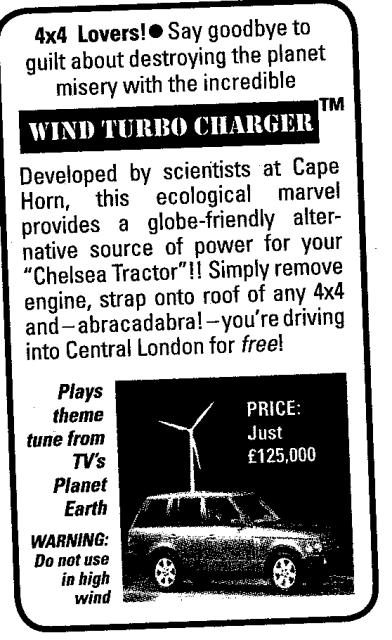
I saw this in the Private Eye Christmas Gift guide and just had to share it. Do you know a 4x4 driver with a conscience? This is just the thing for their stocking!
Sunday, December 10, 2006
Biofuels - the truth!
Here's a letter I've just sent to the Independent:
"It’s time to nail the lie that bio-fuels are carbon-neutral. (Brown’s ‘green’ tax changes hit biofuel, 8th November) Growing crops for bio-fuel absorbs the carbon that bio-fuels emit, but it does not remove the emissions created in planting, fertilising, harvesting, transporting and processing these crops before they can be made into fuel.
Bio-fuels are not green. The EU demands that 5.75% of all road fuel should be biofuel by next year but we will have to import the crops to meet this target because Europe does not have enough agricultural land. In Brazil they cut down the rain forest to grow more sugar cane for ethanol; in Malaysia they cut down the rain forest to grow oil palms; in the US they subsidise the production of ethanol from wheat and maize, leaving less grain surpluses for needy nations.
The truth is that in the face of climate change and energy shortages we are desperately seeking substitute fuels so that we can continue our present lifestyles. It is time we managed energy demand rather than assuming we will always be able to expand supply. We must plan for fundamental changes; otherwise the imminent oil shock, gas shock, electricity shock and very-cold-houses shock really will be a shock."
"It’s time to nail the lie that bio-fuels are carbon-neutral. (Brown’s ‘green’ tax changes hit biofuel, 8th November) Growing crops for bio-fuel absorbs the carbon that bio-fuels emit, but it does not remove the emissions created in planting, fertilising, harvesting, transporting and processing these crops before they can be made into fuel.
Bio-fuels are not green. The EU demands that 5.75% of all road fuel should be biofuel by next year but we will have to import the crops to meet this target because Europe does not have enough agricultural land. In Brazil they cut down the rain forest to grow more sugar cane for ethanol; in Malaysia they cut down the rain forest to grow oil palms; in the US they subsidise the production of ethanol from wheat and maize, leaving less grain surpluses for needy nations.
The truth is that in the face of climate change and energy shortages we are desperately seeking substitute fuels so that we can continue our present lifestyles. It is time we managed energy demand rather than assuming we will always be able to expand supply. We must plan for fundamental changes; otherwise the imminent oil shock, gas shock, electricity shock and very-cold-houses shock really will be a shock."
Thursday, December 07, 2006
How green is Brown?
New green taxes were expected in yesterday's pre-budget statement, and when they came they upset the environmental lobby and everyone else as well.
Sir Nicholas Stern's recent report on the costs of climate change said that every country should devote 1% of GDP to combating climate change, but the new taxes are estimated to cover little more than a tenth of that. We saw an increase in petrol duy of 1.25p/litre and a doubling of air passenger duty. Stamp duty will also be abolished on "zero carbon-emission" homes for a limited period. This will apparently encourage more to be built, though there will be no immediate benefit from the new rules because there is no stamp duty on new homes, only on the sale of existing properties. Apparently such homes could save 8m tonnes of carbon per annum by 2050; not a great deal compared with the UK's total annual emissions of 150m tonnes.
The petrol duty was seen as not nearly enough by Greenpeace. They wanted the Chancellor to bring back the "fuel escalator" which added regualr increases to the price until the government abandoned it in 2000 in the face of the fuel protests which blockaded refineries. Transport organisations said the increase was unjustified as it would simply put up the prices of everything in the shops. There was criticism of the air passenger levy as well: it would not stop people flying but simply cost them more.
The whole problem with green taxes is surely that if people pay them, the policy has failed. If taxes are supposed to stop people doing things that will harm the environment they will only work if people have an alternative. Otherwise, it's just gesture politics and another way of getting money out of people!
Sir Nicholas Stern's recent report on the costs of climate change said that every country should devote 1% of GDP to combating climate change, but the new taxes are estimated to cover little more than a tenth of that. We saw an increase in petrol duy of 1.25p/litre and a doubling of air passenger duty. Stamp duty will also be abolished on "zero carbon-emission" homes for a limited period. This will apparently encourage more to be built, though there will be no immediate benefit from the new rules because there is no stamp duty on new homes, only on the sale of existing properties. Apparently such homes could save 8m tonnes of carbon per annum by 2050; not a great deal compared with the UK's total annual emissions of 150m tonnes.
The petrol duty was seen as not nearly enough by Greenpeace. They wanted the Chancellor to bring back the "fuel escalator" which added regualr increases to the price until the government abandoned it in 2000 in the face of the fuel protests which blockaded refineries. Transport organisations said the increase was unjustified as it would simply put up the prices of everything in the shops. There was criticism of the air passenger levy as well: it would not stop people flying but simply cost them more.
The whole problem with green taxes is surely that if people pay them, the policy has failed. If taxes are supposed to stop people doing things that will harm the environment they will only work if people have an alternative. Otherwise, it's just gesture politics and another way of getting money out of people!
Thursday, November 30, 2006
Download my presentation
Next week I shall be talking to a conference organised by the Institute of Actuaries. My theme is, of course, "Will climate change your life?" and I shall also be looking at the prospects and problems of the energy crisis.
If all goes well, the presentation will be available for download as an MP3 file here. Look for it from Tuesday 5th December.
If all goes well, the presentation will be available for download as an MP3 file here. Look for it from Tuesday 5th December.
End of the road for hydrogen?
With climate change on everyone’s mind and rumours of an energy crisis, what could be better than a car which doesn’t run on fossil fuels and has no emissions except water? BMW’s new Hydrogen 7 fits the bill. This is the V-12 BMW 7 modified to run on hydrogen. It has a petrol tank as well; it also runs on petrol, which is handy if you are far from the UK’s only hydrogen filling station – one of only six in the world.
Of course, if hydrogen catches on there will be filling stations all over the country, won’t there?
Hydrogen cars sound ideal, but there are practical problems. First, the hydrogen tank takes eight minutes to fill and it takes up most of the boot space. Even then, the hydrogen tank provides a range of only 125 miles. To get enough hydrogen into the fuel tank it has to be chilled and liquefied. Gradually it warms up and boils away, so if you don’t use the car over the weekend you’ll find less in the tank. Park up at the airport while you take your three-week holiday and when you get back it’ll be nearly empty.
The fact that the hydrogen has to boil off for safety reasons may be why hydrogen vehicles are illegal in France. Even over here you are advised not to park the vehicle in an enclosed car park. You cannot see hydrogen, you cannot smell it and it burns with an invisible flame. Like petrol vapour, when mixed with air it is highly explosive. At least you can smell petrol.
Where does hydrogen come from? It is either extracted from natural gas or electrolysed by passing a current through water. Extracting hydrogen from natural gas leaves carbon dioxide, which must be captured – otherwise the process produces as much CO2 emissions as if you had just burnt the gas. Electrolysis produces no CO2, but it does produce a lot of waste heat so the energy content of the hydrogen is significantly less than the energy of the electricity used. Electricity itself comes from coal, oil or nuclear, and the electricity produced is also much less than the fuel put into the generation process. Producing hydrogen this way is very inefficient.
All these factors make it very doubtful that hydrogen will be the fuel of the future. As we approach Peak Oil and petrol becomes more and more expensive, economies and cutting back on our travel will be the only solution.
How will you change your lifestyle when petrol costs £5/litre?
Of course, if hydrogen catches on there will be filling stations all over the country, won’t there?
Hydrogen cars sound ideal, but there are practical problems. First, the hydrogen tank takes eight minutes to fill and it takes up most of the boot space. Even then, the hydrogen tank provides a range of only 125 miles. To get enough hydrogen into the fuel tank it has to be chilled and liquefied. Gradually it warms up and boils away, so if you don’t use the car over the weekend you’ll find less in the tank. Park up at the airport while you take your three-week holiday and when you get back it’ll be nearly empty.
The fact that the hydrogen has to boil off for safety reasons may be why hydrogen vehicles are illegal in France. Even over here you are advised not to park the vehicle in an enclosed car park. You cannot see hydrogen, you cannot smell it and it burns with an invisible flame. Like petrol vapour, when mixed with air it is highly explosive. At least you can smell petrol.
Where does hydrogen come from? It is either extracted from natural gas or electrolysed by passing a current through water. Extracting hydrogen from natural gas leaves carbon dioxide, which must be captured – otherwise the process produces as much CO2 emissions as if you had just burnt the gas. Electrolysis produces no CO2, but it does produce a lot of waste heat so the energy content of the hydrogen is significantly less than the energy of the electricity used. Electricity itself comes from coal, oil or nuclear, and the electricity produced is also much less than the fuel put into the generation process. Producing hydrogen this way is very inefficient.
All these factors make it very doubtful that hydrogen will be the fuel of the future. As we approach Peak Oil and petrol becomes more and more expensive, economies and cutting back on our travel will be the only solution.
How will you change your lifestyle when petrol costs £5/litre?
Tuesday, November 21, 2006
The end of oil?

Among all the media fuss we get about climate change, very occasionally we get a hint that there might be problems with energy on the horizon. The British government published an energy review earlier this year, which led to a lot of fuss about whether or not we were going to build more nuclear power stations, and whether we would be consulted about or not. Actually, although nuclear provides 21% of the UK's energy, that's only about 7% of total energy demand. As far as transport is concerned, nuclear is relevant only to electric trains or trams and the very few electric road vehicles that exist, because nuclear only provides energy in the form of electricity. (The day they build a nuclear car I'll give up driving!)
The truth is that the world is facing an energy shortage - not just electricity, but oil, gas and, to a lesser extent, coal. The UK in particular has changed in a generation from a nation totally self-sufficent in energy to one importing over 50% of its coal, 5% of its oil and 10% of its gas. Gas is the fuel we use most of, and by 2020 we will be importing about 90%.
Peak Oil is the point where the world reaches the maximum possible level of oil production. Peak Gas is the same for gas. The US reached its own peak in 1970; the North Sea has also passed its peak. Peak Oil for the whole world is expected in 2010. That's right - 3 years away! That won't be the end of oil, of course, just of cheap oil. We're used to paying more each year. We can cope with 95p/litre or £5/gallon. How would £10/gallon affect you - or £20? The truth is that the level of rises we can expect will demand radical life-style changes. Today you may drive a 4x4 (SUV) because you can afford it; in 10 years many people may not be able to run a car at all.
What started me thinking about this was the new report from LogicaCMG published today: "Mind the Gap" You can find it at http://www.logicacmg.com/United_Kingdom/5012
At least someone is at last taking our energy position seriously! Also have a look at the link for ASPO - theAssociation for the Study of Peak Oil and Gas.
Monday, November 06, 2006
So will climate change your life?
The answer seems to be "Yes! Immediately! In all sorts of terrible ways! We must act NOW!"
Maybe. I've created this blog because I believe that people are in danger of overstating the case. I don't deny we've got a problem, I just don't believe that we can be so specific about what it is, and what we can do about it.
I think we're ignoring a bigger and more immediate problem - Peak Oil. Peak Oil is where the oil begins to run out - where the price goes up and we go short. And the price goes on going up. I predict that we'll see $100/barrel by Christmas, and that will just be the start. At least if we can't afford to start our cars we won't be emitting any CO2!
What do you think about global warming and climate change? Is it the biggest threat to human civilisation, or "the biggest hoax ever perpetrated on the American people" ?
Maybe. I've created this blog because I believe that people are in danger of overstating the case. I don't deny we've got a problem, I just don't believe that we can be so specific about what it is, and what we can do about it.
I think we're ignoring a bigger and more immediate problem - Peak Oil. Peak Oil is where the oil begins to run out - where the price goes up and we go short. And the price goes on going up. I predict that we'll see $100/barrel by Christmas, and that will just be the start. At least if we can't afford to start our cars we won't be emitting any CO2!
What do you think about global warming and climate change? Is it the biggest threat to human civilisation, or "the biggest hoax ever perpetrated on the American people" ?
Subscribe to:
Posts (Atom)