..unless people read it! I learnt the other day that people are most likely to visit a blog if they have read about it in someone else's blog. Apparently this beats search engines and any opther form of referral. I got this information from Graham Jones who specialises in internet marketing and optimising your presence on the web. Here's a link to his blog - http://www.grahamjones.co.uk
It's worth a visit - he's always giving away free stuff!
And if you write a blog on energy and climate change issues as I do, send me a link and I'll put it in another post - and I hope you'll do the same for me!
Tuesday, March 13, 2007


It's the law
...or at least it soon will be. Today the British government publishes its Climate Change Bill which is expected to set 5-year targets for carbon dioxide emissions. This comes after a weekend when the Conservative opposition were making it clear how green they were. Bit of a balancing act - they want to restrict air travel, but they don't want to upset families who might vote for them so maybe they will target the frequent fliers. Gordon Brown has also set out his stall in a speech, making it clear that he's green and voter-friendly at the same time.
The bill has already attracted criticism. Why have 5-year targets and not annual targets? If things are as desperate as the press and politicians tell us surely we should be watching the situation week by week. It's easy to be cynical and assume that climate change is just another bandwagon and a convenient excuse for raising more tax.
My own view is that the whole thing is far too simplistic. The unspoken message is that if we cut carbon dioxide we will stop global warming, avoid climate change and everything will go on as normal. In fact, the only effect we may have is to make future climate change less bad than it might otherwise have been. If we cut carbon dioxide by cutting our fossil fuel consumption we will also cut production of the other nitrous and sulphurous pollutants than no-one ever mentions, so that might be a hidden bonus.
The real threat of course is Peak Oil. As production volumes decline we will be forced to use less, travel less and consume less, but we could never tell that to the voters. As conventional oil declines it's likely that we will start exploiting oil from coal, shale or tar sands. And when we do that you can forget carbon dioxide limits or pollution controls!
Friday, March 09, 2007
2020 vision at the EU
This week European Union leaders have been debating carbon dioxide (CO2) emissions and they have a firm commitment to achieve at least a 20% reduction of greenhouse gas emissions by 2020 compared to 1990. Furthermore, they will increase energy efficiency in the EU so as to achieve the objective of saving 20% of the EU's energy consumption compared to projections for 2020,
Central to this is a binding target of a 20% share of renewable energies in overall EU energy consumption by 2020 and a 10% binding minimum target to be achieved by all Member States for the share of biofuels in overall EU transport petrol and diesel consumption by 2020.
Leaving aside the controversy generated by Channel 4’s film – whether CO2 reduction is possible or worth while – there must still be doubts about whether any of this is achievable. Elsewhere in this blog I have commented on how biofuels are much less green than people would like to think. Biofuel crops absorb CO2, but growing, harvesting and processing them takes up so much energy that the net gain is small or in some cases negative. Growing the crops puts pressure on food crops or rain forests, and to some extent we will burn green fuels while exporting the disadvantages of the fuels to third world countries where the crops are grown.
Biomass is part of the way towards reaching the EU’s 20% target. Today Drax Power, which runs the UK’s largest power station, announced plans to grow biomass on an area equivalent to one fifth of the land of Wales. This will produce sufficient fuel to provide 10% of the requirements of Drax. The station produces 8% of the UK’s electricity, so biomass will account for just 0.8%. If we took over the whole of Wales to grow biofuel crops we would still only achieve 4% of the UK’s electricity – and where would we put the Welsh? -
The Great Global Warming Hoax
Last night’s Channel 4 documentary has caused a great deal of comment.
The film didn't say that global warming wasn't happening; just that man-made co2 wasn't the cause. Whether they are right or wrong, we need to cut fossil fuel use because it's finite and it's beginning to run out. That will cut co2 emissions, and, depending on your point of view, that's either a bonus or irrelevant!
Also we should recognise that there are two aspects to global warming (or overheating, as I prefer to call it - warming is stable and essential to life.) One is trying to stop it, and that's undeniably difficult and may not work. The other is that we are observing the effects of global overheating through climate change and we should be doing what we can to protect ourselves, and others, against those effects.
If we go ahead with a high-carbon solution to the 3rd world's energy shortage we will raise expectations, invest a lot of money and end up with something which doesn't work when the fuel gets too expensive. We're talking 3-5 years.
Focussing solely on co2, and solely on its climatic effects, is very short-sighted. It is absorbed by the seas and it changes the acidity of the seas and affects the fish and other organisms that live there. That's the base of the food chain. When we burn fossil fuels and emit co2 we also emit other pollutants, particularly nitrous compounds. These pollute our air, our food and rivers and seas, again damaging the very environment we live in.
It would be great to be able to rely on one television programme and say that there's no problem at all - we can go on as usual, only more so. The oil is running out (gas too, though maybe 30 years later) and in the short term we can get oil from coal, shale and tar sands. All of these are highly polluting, but if we can create a consensus that co2 doesn't matter the oil companies will be happy to exploit these resources. They will ignore the energy inputs, the vast quantities of fresh water needed and contaminated water released. Life will continue as usual, we'll just run out quicker.
I am firmly against the eco-warriors who want to smash capitalism and put the blame on multinationals, George Bush and anyone else they can think of. I am very concerned that the arguments are so polarised, because I believe that there is a middle way, a rational, pragmatic approach to the changes on our planet and a sensible re-evaluation of the risks and the actions we can take. Business as usual is not an option, but selling the car, putting out all the lights and living on bread and water in a tent is not a sensible strategy either!
That’s why I believe in common sense on climate change.
Tuesday, March 06, 2007
Bush goes bio
Newspaper reports claim that there are signs at last that the White House is taking the environment seriously. This week President Bush was in Brazil to discuss the new ethanol economy - road fuel manufactured from plants. To me this seems more of a realisation that fossil oil is running out, rather than a desire to use "green" fuels. There are serious doubts in any case over whether biofuels are truly green. While the plants used for biofuels do absorb carbon dioxide as they grow, they do not absorb all the co2 released by the whole growth/harvest/processingrefining/use cycle. Some say that the energy input is greater than the energy content of the biofuel produced. Land used for fuel crops displaces food crops, or in some cases displaces rainforest. Cutting down the rainforest releases carbon dioxide and so removes part of the largest co2 absorber in the world. Growing fuel crops instead of food means poorer nations may go hungry.
The signs are that fossil fuel shortages -Peak Oil- are just around the corner. There will never be enough biofuel to replace all the oil we now use. It's a good plan to plan to use less. At least you'll save money and it won't hurt as much when shortages really bite!
The signs are that fossil fuel shortages -Peak Oil- are just around the corner. There will never be enough biofuel to replace all the oil we now use. It's a good plan to plan to use less. At least you'll save money and it won't hurt as much when shortages really bite!
Thursday, March 01, 2007
Learning to commute/commuting to learn
Today the nation's 10 and 11-year-olds learn which school they will be allowed to attend from next September. Parents are determined that their offspring will attend a "good" school and make every effort, including moving house into the right area, to make sure this happens. If it doesn't many are expected to appeal.
Unfortunately, the "good" school is all too frequently not the local school. Children are learning to commute for hours each day to get to the chosen establishment. Parents drive them or fetch them, or put them on buses or trains. Some even go by taxi. One father was heard to remark that all this commuting would "prepare them for later life."
You can make up your own mind whether commuting is part of a desirable lifestyle. As long as people can afford it, they'll do it. Whether the planet can afford it is not a question that most people take into account. If Peak Oil truly happens in the next few years then the spiralling cost of petrol will make many people think again. Economy is the only long-term solution, and that means self-sufficient communities which provide the full range of amenities within minimal travelling distance. The government will have to think again about closing local post offices, maternity and A&E departments, and centralising schools. Mind you, that might be more expensive, because governments don't count the extra travelling costs for individuals.
And what would it really be like without a car? Several thousand people in SE England are finding out today as their cars shudder to a halt and need repairs costing hundreds of pounds. Contaminated petrol is supposed to be the cause, but no-one has yet taken responsibility and the actual contaminant has not been identified.
Wednesday, February 28, 2007
Getting the message across
Last night I gave a presentation on energy and climate change to a group of 50 actuaries here in York. It went well, and there were several questions afterwards.
The problem is that it's a very serious subject, and also quite complex. Actuaries are used to difficult concepts of course - they spend their time deriving mathematical models of insurance risks. I think I kept their attention, because no-one walked out before the end!
Still, it would be good to inject a bit of humour into the proceedings. How can I make climate change amusing without making it trivial?
Any ideas? Any climate change jokes?
Wednesday, February 21, 2007
Some light on the problem.
Australia, along with the United States, gets a lot of criticism for not signing up to the Kyoto Protocol on the reduction of carbon dioxide emissions. While the US has the highest level of emissions in the world, Australia, at over 500m tonnes of CO2 per annum, has the highest level of emissions per head of population. Surprising, then, that their prime minister has just announced that incandescent light bulbs are to be phased out by 2010, in favour of compact fluorescent lamps (CFL).
Incandescent light bulbs, the normal filament bulbs, produce their light from a white-hot wire. The problem is that 90% of the energy used is lost in heat. CFLs use energy much more efficiently – and they last a lot longer: 8000 hours rather than 1000 hours. They are more expensive to buy, but prices are coming down and the last lot I bought on the internet came to well under £2 each (including postage).
Australia is not the first to introduce a CFL policy. Cuba started to change over to CFLs two years ago, and when I was there in January 2007 I didn’t see a single traditional filament bulb.
Tuesday, February 13, 2007
Underground Coal Gasification - (Press Release)
Last week, London hosted the most significant and extensive conference on Underground Coal Gasification ever held. Over 100 delegates from 19 countries heard speakers from around the globe updating on projects and Technology in China, India, Australia, USA and Europe.
The conference was held at the London headquarters of ABN AMRO and organised by the UCG Partnership, and included major industry players, government and academia.
Underground Coal Gasification is a method of converting un-worked coal into a combustible gas, which can be used for industrial heating, power generation or the manufacture of hydrogen, synthetic natural gas or diesel fuel. The gas can be processed to remove its CO2 content, thereby providing a source of clean energy with minimal greenhouse gas emissions.
World Energy Consumption in 2004* breaks down into 41% from oil, 23% from natural gas, 23% from coal,6% from nuclear, 4% from hydro and 3% from renewables.
However, world proven reserves 2005** has oil accounting for 19%, gas with 17% and coal with a massive 64%. Add total reserves to total resources and coal accounts for 95% of the fossil fuel energy content of the planet*** – hundreds of years of energy.
Delegates heard that UCG represents a real answer to the energy gap issue since UCG provides security of supply and a low cost clean energy with substantial volume. Russia, Australia, USA, India, China, South Africa and the UK all have projects developed or being developed with plans being made for further studies in Ukraine, Poland, Hungary, Ireland and Pakistan.
The technology of UCG is now ready for scale-up to large projects to produce syngas for power generation and coal to liquids. Security of supply, the potential for CO2 capture and storage, the lower costs of gas production and its rapid development to fill the energy gap are the principal motivators for the vast increase in activity in UCG.
The conference urged the UCG Partnership, which represents the industry and provides public information on UCG, to continue to urge Governments to provide a workable framework in which UCG projects can flourish and develop quickly. This includes an easier licensing, a simpler environmental and planning framework, risk management and the removal of unnecessary bureaucratic red tape. Encouragement from the very top of Government is needed urgently.
Sources:
*USEIA, 2005
**BP, 2006
***AAPG and BP
Monday, February 12, 2007
Podcast
Here's a brief summary of my views on energy and climate change. Download the MP3 file here.
FAR more
Correcting my earlier post…
The Fourth Assessment Report (FAR) published last week by the IPCC (Intergovernmental Panel on Climate Change) was in fact only the preliminary summary. The full report will be published later in the year. The document we have so far is the summary and guide for policy-makers.
As the New Scientist points out, this is a rather special type of document. It is not a peer-reviewed paper. It has been subjected to political scrutiny and editing, to provide a text acceptable to all governments. Apparently the attitude of the US was remarkably different this time, reflecting a power-shift following the success of the Democrats in the mid-term elections.
Some people (not me, unfortunately) have already seen the full report. From this they conclude that much has been left out of the summary. For example, scientists are beginning to think that ice sheets could melt much more rapidly than previously thought. Research is not yet conclusive, and for this reason the theory was excluded from the study. You can argue if nothing is yet proven on this it would be scare-mongering to include it. On the other hand, if we have identified a potential problem, should we not flag it up as a potential risk?
Sea levels may rise faster than expected; there is observable evidence to show that this is the case. This is not in the summary report as it is inconsistent with the models currently used. The full report, due in July I think, will make interesting reading.
There’s no point in waiting; we must take action now. But we must act with care, and be ready to modify our actions as our knowledge grows and our understanding of the climate system develops.
Tuesday, February 06, 2007
Trapped Wind
The problem with wind power is matching supply with demand. High winds at night can produce more power than needed while on cold, still days the turbines produce nothing at all. Storing electricity has always been difficult and most systems, like flywheels, capacitors or lead-acid batteries are either too expensive or too small. Pump storage is a large-capacity solution. It uses surplus power to pump water up to a reservoir. This water is released to turn hydro-electric turbines at times of high demand. Pump storage is expensive, and needs the right kind of geography with mountains and lakes.
Research in Australia (New Scientist 13th January 2007) has developed the flow battery. This uses electrolytes consisting of chemical solutions based on the element vanadium. The electrolytes are pumped into the flow cell where they are charged by the wind turbines and then pumped out to storage tanks. The size of the battery is therefore only limited by the size of the tanks. When the wind drops the electrolytes are pumped back into the flow cell where they release their electricity. Systems have already been successfully installed and improved the productivity of wind farms by buffering the differences between supply and demand. So far the flow battery is too large to fit in a vehicle, but research continues with alternative chemical compounds for the electrolyte.
At this stage the system is expensive and the future success of flow storage batteries must depend on the cost and availability of vanadium.
Monday, February 05, 2007
FAR Out
The Fourth Assessment Report (FAR) has just been released by the United Nations’ Intergovernmental Panel on Climate Change. (IPCC) No real surprises. We expected the news to be bad and the report says things are getting worse and urges governments again to take action to avoid total catastrophe.
How likely is it that governments will respond? The United States and Australia refused to sign up to the Kyoto Protocol on the reduction of greenhouse gases, and the process of designing a new protocol, to apply after 2012, is stalled. While Britain will reach its Kyoto target, this is mainly due to the closure of coal-fired power stations in the late 90s. Britain’s greenhouse gas emissions are once again rising. Britain is still building roads and expanding airports. Germany has just buckled under to the automotive lobby and relaxed emission standards for new cars. China, which as a developing country was not required to make emission reductions under Kyoto, continues to expand, to use increasing quantities of coal and to produce 15% of the world’s CO2 emissions.
Cutting emissions means cutting the use of fossil fuels or installing equipment to trap the CO2. In both cases this means extra costs: in both cases this will depress the economy. The US economy is already in bad shape so industrialists resist anything that might make it worse. Their tactic is to attack the science and suppress the evidence. The New Scientist (3rd February 2007) claims this is happening with the support of the US government, and that lobbyists who used to deny the danger of smoking are now attacking the climate scientists.
Not a reassuring prospect.
Thursday, February 01, 2007
The Book
My book, "Will climate change your life? How to drive a 4x4 and still save the planet" will be published on 26th February.
Click here to find out more and to receive a free copy of my e-book "Europe's Energy Conundrum - the next 10 years."
Click here to find out more and to receive a free copy of my e-book "Europe's Energy Conundrum - the next 10 years."
Peak Oil - a Cuban case study
In January I spent two weeks in Cuba, and before I went I saw the video “The Power of Community – how Cuba survived Peak Oil” (www.communitysolution.org/cuba )
Cuba suffered an economic shock when the Soviet Union collapsed in 1990. For the previous 30 years it had been receiving substantial support, including technical assistance and cheap oil in exchange for sugar. All this stopped almost overnight. For the same 30 years the United States has operated a trade embargo and travel ban against Cuba, and this continues to the present day.
Cuba has some oil of its own, though not nearly enough for transport, electricity generation and – crucially – fertiliser and pesticide production. At the time of the Soviet collapse Cuba was using more fertiliser per acre than the US; agricultural production fell dramatically. Food rationing was introduced but the population began to suffer from malnutrition. The film shows how large state farms were broken up into individual co-operatives and how every spare piece of land in the cities was turned over to growing vegetables. With no fertiliser, agriculture had to be organic, and with no fuel for tractors, oxen and horses returned to the land. Farming became labour-intensive; more and more people became farmers.
In the early 90s power cuts were common - lasting up to 24 hours. If people could get to work (and transport was severely disrupted) they often had nothing to do because there was no power. It's only in the last few years that electricity cuts have largely disappeared. The solution has come in three ways. First, the ageing national grid has been superseded to a large extent by building a lot of neighbourhood generators to replace the few large power stations and the nuclear station that the soviets never finished. (Not CHP - in that climate you just don't need the heat!) Secondly the government has managed demand, and you don't see filament bulbs anywhere - they're all CFLs. There is also a programme to replace domestic appliances with more efficient ones. (But Cuba is a poor country, and the volume of domestic appliances must be small.) Thirdly, Fidel - or Raoul - is now big chums with Hugo Chavez in Venezuela which has lots of oil. (This is fortunate, as all generating plants, large and small, seem to be oil -fuelled.) Cuba has sent 20,000 doctors to Venezuela and receives oil in return. I've not been able to determine whether this is as much as Russia used to provide.
There is still a transport problem exacerbated both by oil shortages and by the lack of spare parts for vehicles. Mass transit is just that: people packed into goods lorries. Government vehicles of all kinds are expected to take hitch-hikers, and yellow-uniformed hitchhike co-ordinators are stationed at the side of the road to ensure that they do. Cuba was one of the first Latin-American countries to have railways. They are still there, but like the roads they are long overdue for repairs and maintenance.
So has Cuba successfully survived Peak Oil? The country certainly suffered an oil shock with far-reaching consequences, and while things are better than they were in the early 90s people say that things are still not what they were before the Soviet Union collapsed. The on-going US embargo has continued to make things difficult, though ironically Cuba still buys millions of dollars of food from the US, and Cuban expats in the States also send about $1billion back home each year. With only 11m people in 111,000 km2, [UK 60m – 242,000km2] the country has the potential to be self-sufficient in agriculture, but the command economy has been unable to achieve this. The 2006 Annual Economic Review notes that MPs at the Economic Committee complain of labour discipline problems which lead to low productivity, corruption and squandering.
Do we have a lesson for the rest of the world? The world will suffer similar problems from Peak Oil, but it is unlikely that they will arise quite as suddenly as they did in Cuba. The most important difference is that Cuba has replaced its Russian oil, at least to some extent, with Venezuelan oil. The world doesn't have such an option.
On a global scale, when the oil's gone, it's gone!
Wednesday, December 20, 2006
Peak Oil
Peak Oil is the point at which global oil producution reaches its maximum, and from there on it's all downhill. With oil demand continuing to grow, the only consequences can be shortages and rapidly increasing prices. Peak Oil is predicted by some (based on experience and scientific analysis) to occur in 2010.
An excellent site on this subject is http://www.powerswitch.org.uk
It might make you think, it might make you worry; but if we have an understanding of what the likely problems will be, we can at least prepare for them.
An excellent site on this subject is http://www.powerswitch.org.uk
It might make you think, it might make you worry; but if we have an understanding of what the likely problems will be, we can at least prepare for them.
Friday, December 15, 2006
The Biofuel debate
The Independent published my letter yesterday and today there was a response from Nigel Clarke of York. (I live in York, too.)
His point was that the energy value from an acre of biofuel crop was much less than the energy value of food grown on the same area.
His point was that the energy value from an acre of biofuel crop was much less than the energy value of food grown on the same area.
Wednesday, December 13, 2006
Carbon or Carbon dioxide?
Apparently the UK emits 2% of the world’s CO2 or 150 million tonnes. I was confused when I saw an advertisement from the Carbon Trust talking about 648 million tonnes, so I phoned them up and then sent the following email.
“Your advertisement in today's Independent talks about annual CO2 emissions of 648m tonnes, while the DTI report "The Energy Challenge" quotes 150m tonnes. One of your customer advisors pointed out that your figure is for CO2 but the DTI figure is the carbon component only. If we take the atomic weight of carbon at 12 and oxygen at 16,carbon accounts for 12/44 of the weight of CO2, or 27%.
"Dividing 150 by 27% gives 550, not 650. Is your figure for CO2, or have you included other greenhouse gases as well? I'm about to publish a book on this, so I need to know the right answer!”
Here’s their reply:
“Dear Mr. Day,
"The figures cover carbon emissions from fuel use and so do not include carbon emissions from other processes or emissions of other greenhouse gases.
"The figure of 648 million tonnes of carbon dioxide (equivalent to 176.4 million tonnes of carbon) is the total UK carbon emission consumption.
This is different from the UK carbon emission production. Our figures differ from the 2002 UK Production Footprint, produced by Defra in 3 key
ways:
* Ours includes aviation fuel use;
* We use slightly higher water transport figures; and
* Our report talks about UK consumption and so includes carbon
emissions from products produced overseas and brought to the UK for consumption (e.g. Chinese T-shirts and German cars). For consistency, our figure excludes emissions from products and services which are produced in the UK but which are then sent overseas for consumption (e.g. Scotch Whisky sent to the Far East). The UK is a net importer of products and services and so our consumption footprint is higher than our production footprint as a consequence.
"There is a breakdown of these differences on page 22 of our report 'The carbon emissions generated in all that we consume', which is available from the Carbon Trust website at this link.
"Note: The figures presented in this report are in terms of carbon not carbon dioxide.”
A clear and comprehensive answer. So now we know!
Monday, December 11, 2006
Green Motoring for Christmas
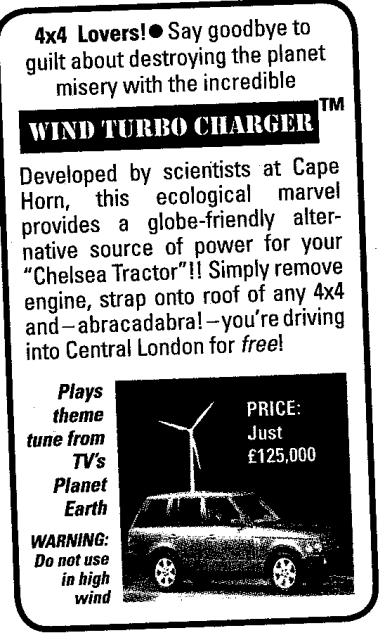
I saw this in the Private Eye Christmas Gift guide and just had to share it. Do you know a 4x4 driver with a conscience? This is just the thing for their stocking!
Sunday, December 10, 2006
Biofuels - the truth!
Here's a letter I've just sent to the Independent:
"It’s time to nail the lie that bio-fuels are carbon-neutral. (Brown’s ‘green’ tax changes hit biofuel, 8th November) Growing crops for bio-fuel absorbs the carbon that bio-fuels emit, but it does not remove the emissions created in planting, fertilising, harvesting, transporting and processing these crops before they can be made into fuel.
Bio-fuels are not green. The EU demands that 5.75% of all road fuel should be biofuel by next year but we will have to import the crops to meet this target because Europe does not have enough agricultural land. In Brazil they cut down the rain forest to grow more sugar cane for ethanol; in Malaysia they cut down the rain forest to grow oil palms; in the US they subsidise the production of ethanol from wheat and maize, leaving less grain surpluses for needy nations.
The truth is that in the face of climate change and energy shortages we are desperately seeking substitute fuels so that we can continue our present lifestyles. It is time we managed energy demand rather than assuming we will always be able to expand supply. We must plan for fundamental changes; otherwise the imminent oil shock, gas shock, electricity shock and very-cold-houses shock really will be a shock."
Subscribe to:
Posts (Atom)